Saba Saba at 36: From the Fight for Multiparty Democracy to Kenya’s Annual Test of Accountability
By Esikuri Dennis
Every year on 7 July, Kenyans pause to remember Saba Saba a day that has become deeply woven into our nation’s democratic history. For some, it is a reminder of courage and sacrifice. For others, it has become a day of protest, hope, grief, and renewed demands for accountability. Yet beyond the headlines and annual demonstrations lies a more important question: What should Saba Saba mean for Kenya today and in the future?
When thousands of Kenyans gathered at Kamukunji Grounds in Nairobi on 7 July 1990, before my coming to this world they were demanding something many citizens today take for granted the right to participate in a multiparty democracy. At the time, Section 2A of the Constitution had entrenched one-party rule, restricting political competition and narrowing civic space. The movement that emerged from Saba Saba was not merely about changing governments; it was about restoring the fundamental democratic principles of political participation, freedom of expression, and accountable governance.
The struggle was costly. Many activists, religious leaders, students, lawyers, journalists, and ordinary citizens faced arrests, intimidation, detention, and violence. Their courage laid the foundation for many of the democratic gains Kenya enjoys today: the repeal of Section 2A, competitive multiparty elections, a vibrant civil society, a freer media landscape, an independent judiciary, devolution, and ultimately the transformative Constitution of 2010.
These achievements deserve recognition. They remind us that democratic progress is neither automatic nor inevitable; it is earned through sustained civic engagement and constitutional reform.
Yet thirty-six years later, Saba Saba continues to draw thousands of Kenyans to the streets. The question is no longer whether Kenya should be a multiparty democracy. Instead, citizens increasingly ask whether democracy is delivering on its promises.
The struggle has evolved.
Where the generation of 1990 fought for political freedoms, today’s generation is demanding effective governance, police accountability, integrity in public office, economic opportunities, social justice, and the full implementation of constitutional rights. Young people, in particular, are asking difficult but legitimate questions: Can they trust public institutions? Will public resources be managed responsibly? Are they safe while exercising their constitutional rights? Does democracy improve their daily lives?
These are not signs that democracy has failed. Rather, they demonstrate that democratic citizenship has matured. In every healthy democracy, citizens continue to hold governments accountable long after constitutional victories have been won. Democracy is not an event marked by elections alone; it is a continuous relationship between citizens and the state.
This evolution places Saba Saba within a broader global tradition. Around the world, societies commemorate historic civic movements not only to honour the past but also to measure the health of their democracies. The American Civil Rights Movement, South Africa’s anti-apartheid struggle, and the Philippines’ People Power Revolution continue to serve as reminders that democratic freedoms require constant protection and renewal.
International human rights law reflects the same principle. The Universal Declaration of Human Rights, the International Covenant on Civil and Political Rights, and the African Charter on Human and Peoples’ Rights all affirm the rights to freedom of expression, peaceful assembly, association, and participation in public affairs. These rights are not privileges granted by governments; they are obligations that democratic states undertake to respect, protect, and fulfil.
For Kenya, Saba Saba has gradually become more than a historical anniversary. It has evolved into what might be called our national civic accountability day—a moment when citizens collectively assess whether the promises contained in our Constitution are being realised in practice.
This also explains why concerns about police accountability frequently dominate Saba Saba commemorations. While law enforcement agencies have a legitimate responsibility to maintain public order and protect lives and property, international standards are equally clear that policing should facilitate peaceful assembly, apply force only when lawful, necessary, and proportionate, and uphold the dignity and rights of every individual. Public confidence in policing is strengthened not through fear, but through professionalism, transparency, accountability, and respect for the rule of law.
Similarly, recurring concerns about corruption, governance, inequality, and public service delivery reflect deeper expectations that constitutional democracy should improve the everyday lives of citizens. Kenyans are no longer asking only who governs them; they are asking how they are governed.
Perhaps the greatest challenge for the future is ensuring that Saba Saba becomes more than an annual cycle of protest and confrontation. It should evolve into a nationwide civic accountability process.
Imagine if every Saba Saba were accompanied by citizen-led accountability scorecards assessing the performance of national and county governments, independent institutions, and public agencies. Imagine communities reviewing progress on healthcare, education, employment, public finance, police reforms, environmental protection, and the socio-economic rights guaranteed under Article 43 of the Constitution. Imagine universities, civil society organizations, faith communities, and youth movements convening public dialogues to evaluate democratic governance using evidence rather than political rhetoric.
Such initiatives would transform remembrance into democratic practice.
As Kenya approaches another electoral cycle amid growing concerns about shrinki ng civic space, public trust, and institutional accountability, the original spirit of Saba Saba remains profoundly relevant. The challenge before us is no longer simply protecting democracy; it is deepening it. Constitutional rights must be matched by constitutional culture. Political freedoms must be accompanied by responsive institutions. Public participation must translate into meaningful public accountability.
Saba Saba should not belong exclusively to activists, politicians, or any single generation. It belongs to every Kenyan who believes that democracy is strengthened when citizens remain engaged, institutions remain accountable, and governments remain faithful to the Constitution.
Thirty-six years ago, Kenyans marched to secure the right to choose their leaders. Today, the unfinished task is to ensure that those entrusted with leadership consistently uphold the values of integrity, justice, equality, transparency, and accountability that our Constitution demands.
The true success of Saba Saba will not be measured by the number of people who gather in the streets each year. It will be measured by the day when citizens no longer need to remind the state to honour the rights, freedoms, and dignity that are already guaranteed under the Constitution.
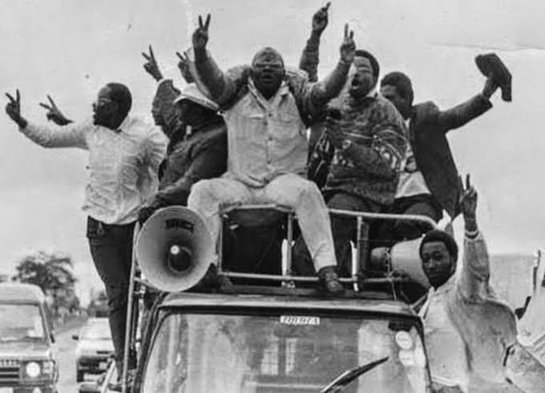
Saba Saba should not simply remind us where we have come from; it should challenge us to decide where we are going. Every generation has its own democratic struggle. The generation of 1990 fought for political pluralism. Today’s generation is called to defend constitutionalism, strengthen institutions, protect civic space, combat corruption, and ensure that democracy delivers justice and dignity for all
Until then, Saba Saba will remain not merely a day of remembrance, but Kenya’s enduring democratic conscience—a reminder that freedom must continually be defended, accountability continually demanded, and democracy continually renewed.
ya,im here
ilzwznlgviusifvwrrgxppmyuhwtmj
The excitement on this site is next level! I had a great run last night and the customer support was super helpful. Give f188game a try for sure.
I’ve tried a few platforms lately and this one is surprisingly smooth. The login process is fast and I didn’t run into any lag. Definitely a solid choice for anyone looking for a reliable spot. Check out mawinbetlogin for a great experience!
Best betting experience I have had in months. The odds are fair and the payout process is transparent. Definitely check out br881betwin.
[8433]ph sky login at app download – slots na madaling manalo,Mag-ph sky login na para sa pinaka mabilis na gcash casino. Alamin din kung paano maglaro ng baccarat at humanap ng slots na madaling manalo. Sali na! visit: ph sky
[7067]Jawara79: Login Daftar Situs Slot Gacor Dana Tanpa Potongan,Jawara79 menyediakan akses login mudah dan daftar jawara79 apk untuk menikmati situs casino live terpercaya. Coba cara main baccarat online sekarang juga. visit: jawara79